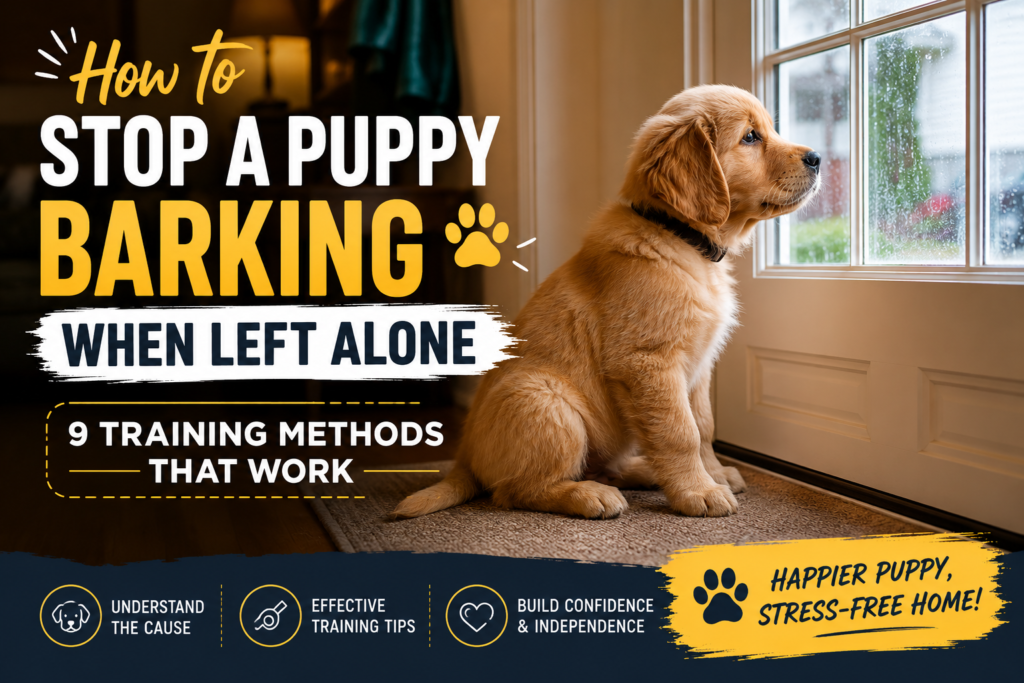
You grab your keys, slip on your shoes, and the moment the front door clicks shut, it begins: a high, frantic bark that follows you down the path and out onto the street. By the time you reach the car you can still hear your puppy crying behind the door, and your stomach twists with guilt. Sound familiar? If your puppy barking when left alone has become the soundtrack to every school run, work commute, or quick trip to the shops, you are not a bad owner and your puppy is not a bad dog.
Here is the single most important thing to understand before we go any further: barking is communication, not misbehaviour. A puppy left alone is not plotting revenge or being naughty. They are a baby animal, hard-wired to call out for their family the second they feel isolated. The good news is that this is one of the most fixable behaviour problems there is. In this guide you will learn exactly why it happens, how to tell normal puppy fussing apart from genuine distress, and nine proven training methods that gently teach your puppy that being alone is safe, calm, and even enjoyable.
Why Puppies Bark When Left Alone
Before you can stop the noise, you need to understand what is driving it. A puppy barking when left alone is almost always reacting to one (or several) of the following triggers. Identifying the right cause is what turns random effort into a training plan that actually works.
Natural Pack Instinct
Puppies are pack animals. In the wild, a pup separated from the group is in real danger, so nature gave them a powerful instinct: when alone, call out loudly until someone comes back. Barking and whining are simply your puppy doing exactly what millions of years of evolution programmed them to do. It feels like a crisis to them, even if it is only a ten-minute trip to the post box for you.
Separation Distress
Young puppies form an intense bond with their humans, and being apart triggers a genuine stress response, complete with a surge of cortisol and adrenaline. This is different from full-blown separation anxiety (more on that below), but the feeling of “where did my family go?” is very real and is one of the most common reasons a puppy cries when left alone.
Boredom and Excess Energy
A puppy with a busy brain and unspent energy will find a way to fill the silence, and barking is an easy outlet. Without anything to chew, sniff, or solve, the minutes drag and the frustration builds. Much of the noise blamed on anxiety is, in reality, plain boredom that is simple to fix with enrichment.
Fear and Insecurity
The world is enormous and unfamiliar to a new puppy. A creaking radiator, a delivery van, footsteps in the hallway, or a sudden bang can all feel threatening when there is no reassuring human nearby. A fearful puppy barks to ward off the scary thing and to summon backup.
Lack of Routine
Puppies feel safest when life is predictable. If departures, meals, walks, and naps happen at random times, your puppy never learns the comforting rhythm of “you always come back.” Inconsistency keeps their nervous system on high alert, and that low-level stress spills out as barking the moment they are alone.
Is It Separation Anxiety or Normal Puppy Behaviour?
This is the question that keeps new owners awake at night, and getting the answer right matters enormously. Most puppy whining when alone is completely normal adjustment behaviour that fades with gentle training. True separation anxiety is a more serious clinical condition that needs a structured, sometimes professional, approach. Pushing a normal puppy too hard can create anxiety, while ignoring genuine anxiety can make it worse, so learning to tell them apart is essential.
As a rough guide: a normal puppy protests for a few minutes and then settles, eats, and sleeps. An anxious puppy panics, cannot settle at all, and may still be distressed an hour later. The table below breaks down the key differences.
| Behaviour | Normal Puppy Adjustment | Possible Separation Anxiety |
|---|---|---|
| Timing of barking | Fusses for 5–10 minutes, then settles | Escalates and continues for 30+ minutes or the whole absence |
| Intensity | Whining, occasional barks, then quiet | Frantic, high-pitched barking, howling or screaming |
| Eating | Will happily take a stuffed toy or treat | Refuses food entirely until you return |
| Body and recovery | Relaxes, naps, plays once settled | Pacing, drooling, panting; cannot rest at all |
| Destruction | Chews a stray toy out of boredom | Targets doors and windows trying to escape |
| On your return | Pleased but calms quickly | Frantic, over-the-top greeting that lasts several minutes |
Example: Bella the eight-week-old cockapoo barks for six minutes after her owner leaves, then tucks into her frozen Kong and falls asleep. That is normal. Across the road, Milo the rescue puppy barks non-stop for an hour, soaks his bed with drool, and has scratched the paint off the back door. That is a warning sign of separation anxiety. If your puppy looks more like Milo, our in-depth guide to dog separation anxiety, its signs, causes and how to calm your dog fast walks you through the full recovery plan step by step.
Signs Your Puppy May Be Struggling
Barking is the symptom you hear, but a struggling puppy usually shows several signs at once. Set up a phone or pet camera and watch the first 30 minutes after you leave it is the single most useful thing you can do. Look out for the following:
- Barking, howling or yelping that starts within seconds of the door closing and does not ease off.
- Whining and crying in long, repetitive bouts rather than a few short protests.
- Pacing back and forth on the same path, often near the door you left from.
- Scratching at doors, frames, or windows in an attempt to follow you.
- Destructive chewing aimed at exits and barriers (very different from idly gnawing a toy).
- Accidents indoors from a puppy who is otherwise making good toilet progress stress loosens bladder and bowel control.
- Excessive drooling or panting, shown by a damp chest or wet patches on the bed when you return.
- Refusing food an untouched chew or treat is a strong sign the stress level is too high.
One or two mild signs that fade quickly are usually just your puppy learning. Several intense signs that last the whole absence mean you should slow your training right down and, if needed, seek professional support.
9 Training Methods to Stop Puppy Barking When Left Alone
Here is the heart of the guide. These nine methods work best as a combined plan rather than in isolation, but you can start with whichever fits your puppy and routine. Work patiently, never rush the timeline, and remember that calm consistency beats speed every single time. Tackling puppy barking when left alone is a marathon of small wins, not an overnight fix.
Method 1: Gradual Departure Training (Desensitisation)
Why it works: Your puppy panics because absence feels sudden and total. By building alone-time up in tiny increments, you teach their brain that you always come back, long before panic has a chance to set in.
- Pop behind a door for just 5 seconds, then return calmly before your puppy reacts.
- Build up in small steps: 10 seconds, 30 seconds, a minute, two minutes.
- Mix the durations up so your puppy cannot predict a long absence (e.g. 30s, then 10s, then 2 min).
- Always return during a quiet moment, never mid-bark.
- Over days and weeks, stretch the time until you can comfortably leave the house.
Common mistakes: Jumping from two minutes to two hours, or going back in while the puppy is screaming (which teaches them that noise brings you back). Expected results: Most puppies relax noticeably within one to three weeks of daily practice, with steady gains rather than instant silence.
Method 2: Create Positive Associations With Alone Time
Why it works: If “you leave” reliably predicts “something wonderful happens,” your puppy starts to look forward to your departure instead of dreading it. This is the technique professional trainers call counter-conditioning.
- Choose a special, high-value treat your puppy only ever gets when alone — a stuffed Kong or a smear of xylitol-free peanut butter works beautifully.
- Hand it over the moment you leave, and take it away the moment you return.
- This makes alone time the “best part of the day” rather than a punishment.
- Keep early sessions short so your puppy finishes feeling happy, not abandoned.
Common mistakes: Using the same treat at other times, which removes the magic. Expected results: Within a week or two, many puppies start trotting happily to their spot when they see the special toy appear.
Method 3: Use Interactive and Enrichment Toys
Why it works: A busy brain cannot bark. Puzzle and chew toys give your puppy a job to do, burning mental energy and keeping them occupied through the riskiest first 20 minutes alone.
- Offer a food-stuffed or treat-dispensing toy right as you head out.
- Rotate two or three toys so novelty keeps them interesting.
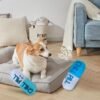
- Pick durable, puppy-safe options a comforting soft toy like this plush capsule squeaker toy can soothe a lonely pup, while a tougher durable chew ball redirects nervous energy into healthy chewing.
- Always supervise a new toy first to check it is safe for your puppy to use unwatched.
Common mistakes: Leaving toys down all day so they lose novelty, or choosing toys too small or flimsy for unsupervised use. Expected results: An immediate reduction in boredom barking, often from the very first session.
Method 4: Exercise and Drain Energy Before You Leave
Why it works: A tired puppy is a calm puppy. A pup who has physically and mentally exercised is far more likely to sleep through your absence than to bark at it. This single habit prevents a huge amount of puppy separation anxiety barking.
- Aim for an age-appropriate walk or play session before any planned departure (a useful guide is around five minutes per month of age, twice a day).
- Add five to ten minutes of brain work sniffing games, scatter feeding, or basic training because mental tiredness is more calming than physical alone.
- Allow a short cool-down so your puppy is relaxed, not over-excited, as you leave.
- Time it so your puppy is ready for a nap right when you head out the door.
Common mistakes: Over-exercising a young puppy (their joints are still developing) or leaving the second they are hyped up from play. Expected results: Many owners notice quieter departures the very same day they add a pre-leaving walk and sniff session.
Method 5: Establish Predictable Daily Routines
Why it works: Predictability is deeply reassuring to a puppy. When meals, walks, naps, and alone time happen at roughly the same times each day, your puppy’s nervous system relaxes because it knows what comes next including the reliable fact that you always return.
- Set consistent times for waking, feeding, walking, play, and rest.
- Build a short, calm wind-down ritual before each departure.
- Always offer a toilet break right before you leave to remove that source of discomfort.
- Keep the routine going at weekends so the rhythm never breaks.
Common mistakes: A chaotic schedule that changes daily, or skipping the pre-departure toilet trip. Expected results: A calmer, more settled puppy overall within one to two weeks, with fewer stress behaviours across the whole day.
Method 6: Avoid Emotional Goodbyes and Hellos
Why it works: Long, gushing goodbyes spike your puppy’s arousal right before the hardest moment of their day, and frantic reunions teach them that your return is a huge, emotional event worth panicking for. Keeping both low-key tells your puppy that comings and goings are simply no big deal.
- Ignore your puppy calmly for a few minutes before you leave no cuddles, no “I’ll miss you so much.”
- Leave quietly and matter-of-factly.
- On return, wait until your puppy is calm before greeting them, then say hello gently.
- Reward four paws on the floor and quiet behaviour, never jumping and frantic barking.
Common mistakes: Emotional farewell speeches and over-the-top reunions that accidentally reward the panic. Expected results: Calmer departures and noticeably less frantic greetings within a couple of weeks.
Method 7: Crate Training Done Correctly
Why it works: Used properly, a crate becomes a cosy den a safe space where your puppy feels protected rather than trapped. A puppy who genuinely loves their crate often settles and sleeps instead of barking. The key word is correctly; a crate must never be used as a prison or a punishment.
- Introduce the crate slowly with treats, meals, and praise so it always predicts good things.
- Let your puppy choose to go in; never force or shove them inside.
- Build up time in the crate while you are still in the room before you ever leave.
- Make it comfortable with soft bedding and a safe chew, and keep the door open during early sessions.
- Only progress to leaving once your puppy relaxes happily inside.
Common mistakes: Using the crate as a time-out, or locking a frightened puppy in this can cause panic and even injury. Expected results: When introduced gradually over two to four weeks, most puppies treat the crate as a calming retreat and bark far less.
Method 8: Background Sounds and Calming Music
Why it works: Silence makes every creak and car door sound alarming, and it also makes the absence of your voice more obvious. Gentle background noise masks startling sounds and has a genuinely soothing effect studies have found classical music and reggae can lower canine stress.
- Play soft classical music, a dog-specific calming playlist, or low-volume talk radio as you leave.
- Introduce the same sound during relaxed moments at home so it becomes a cue for calm.
- Keep the volume low and soothing, never loud or sudden.
- Pair it with the other methods rather than relying on it alone.
Common mistakes: Blaring the TV at high volume, or expecting music alone to fix genuine anxiety. Expected results: A modest but real reduction in reactivity to outside noises, often noticeable straight away.
Method 9: Independence Training Throughout the Day
Why it works: A puppy who shadows you from room to room while you are home has never learned to be okay on their own. Building everyday independence even when you are in the house is what creates lasting confidence and tackles the root of new puppy anxiety when owner leaves.
- Teach a solid “settle” on a mat or bed a short distance from you.
- Practise stepping into another room for a few seconds at a time, then returning calmly.
- Reward your puppy for relaxing alone, even when you have not left the house.
- Gently discourage constant velcro-following by giving them their own comfy spot to rest.
Common mistakes: Allowing the puppy to follow you everywhere and only practising independence when you actually leave. Expected results: A more confident, self-assured puppy over three to six weeks the change that makes every other method stick.
What NOT To Do When Your Puppy Cries When Left Alone
Just as important as the right techniques are the mistakes that quietly make everything worse. Even loving, well-meaning owners fall into these traps, so it is worth knowing them clearly.
- Never punish the barking. Shouting, scolding, or telling your puppy off when you get home only adds fear and confusion. Your puppy cannot connect your anger to something they did 20 minutes ago all they learn is that your return is frightening.
- Avoid anti-bark shouting and “quiet!” yelling. To a distressed puppy, your raised voice can sound like you are barking along with them, which actually encourages more noise. Worse, it teaches them that barking gets your attention.
- Do not be inconsistent. Letting your puppy out the moment they bark on Monday, then ignoring them on Tuesday, teaches them that persistence pays off. Mixed messages are one of the biggest reasons training stalls.
- Resist excessive reassurance. Rushing back in to cuddle and coo every time your puppy whimpers rewards the very behaviour you want to reduce and confirms that being alone really is something to fear.
Aversive tools deserve a special warning. Devices like shock or spray anti-bark collars suppress the symptom without addressing the underlying emotion, and they can make a frightened puppy far more anxious. We explain why a kinder, cause-first approach works better in our guide on how to stop dog barking.
When To Seek Professional Help
Most puppies improve steadily with the methods above, but some need expert support, and recognising that early is a sign of a responsible owner, not a failure. Reach out to a professional if you notice any of the following:
- Severe, unrelenting anxiety your puppy cannot settle at all, even after weeks of patient, consistent training.
- Signs of self-harm broken nails, bloody paws, damaged teeth, or raw skin from frantic escape attempts or obsessive licking.
- Extreme distress non-stop howling for the entire absence, refusing all food, vomiting, or soiling from panic.
Start with a vet visit to rule out any underlying pain or medical issue (discomfort such as joint pain can make a puppy unusually clingy and anxious — see the warning signs in our article on joint pain in dogs). From there, ask for a referral to a qualified, force-free behaviourist. In the UK, look for someone registered with the ABTC or APBC. Genuine separation anxiety sometimes benefits from a combined plan of behaviour modification and, in severe cases, short-term medication prescribed by your vet.
Frequently Asked Questions
How long does puppy separation anxiety last?
Normal puppy fussing usually eases within the first three to four days in a new home, and most puppies can tolerate being left alone calmly by around seven to eight months with consistent practice. Genuine separation anxiety takes longer often several months of structured training and a minority of dogs need ongoing management. Patience and consistency matter far more than speed.
Should I ignore my puppy when he barks?
It depends on the cause. Ignoring brief attention-seeking barks (and rewarding the quiet that follows) is sensible. But ignoring a genuinely panicked, distressed puppy is not kind and can deepen the anxiety. Never simply leave a frantic puppy to “cry it out” instead, lower the difficulty of your training so they can succeed.
Is it okay to let my puppy bark when left alone?
A few minutes of mild protest that settles is normal and fine. Prolonged, frantic barking is not something to let run, because every panicked session reinforces the fear. If your puppy cannot settle, you are leaving them too long too soon shorten the absences and build back up gradually.
Will my puppy grow out of separation anxiety?
Many puppies naturally grow more confident as they mature, especially with good early alone-time training. However, anxiety rarely fixes itself if it is ignored or made worse by inconsistency. The habits you build now decide whether your puppy grows out of it or grows into a more anxious adult.
Can crate training stop barking?
Yes, when it is done correctly. A puppy who has learned to love their crate often treats it as a safe den and settles quietly. But a crate forced on a frightened puppy will increase barking and distress, so always introduce it slowly and positively before relying on it.
Why does my puppy cry when left alone at night?
Night-time crying is usually homesickness combined with a need for the toilet, and it typically fades within the first one to two weeks. A comfy bed, a worn t-shirt that smells of you, a pre-bed toilet trip, and being close enough to reassure them in the early days all help your puppy learn that night-time alone is safe.
How long can I leave a puppy alone?
As a general rule, a puppy can be left for roughly one hour per month of age, up to a maximum of around four hours once they are older. An eight-week-old puppy should only be alone for very short periods. Building up to longer absences gradually is exactly what prevents barking in the first place.
Do calming toys really help with puppy anxiety when the owner leaves?
They genuinely can. Enrichment and comfort toys occupy the mind during the critical first 20 minutes, turning a stressful moment into a rewarding one. They work best as part of a wider plan that includes gradual departures and positive associations, rather than as a standalone fix.
What is the “three bark rule”?
The three bark rule is a common training idea that allows a dog a few alert barks acknowledging they have “done their job” of telling you something — before you calmly cue quiet and reward the silence. It is a useful concept for alert barking, though distressed separation barking needs the gentler desensitisation approach covered above.
Will getting a second puppy stop the barking?
Usually not. Most puppies are bonded to their human, not to other dogs, so a second puppy often means double the barking rather than a cure. Focus on building your puppy’s individual confidence first.
My puppy bites and barks when overexcited are they connected?
They often share a root cause: too much pent-up energy and not enough outlets. The same enrichment and routine that calm barking also reduce nipping. If mouthing is a major issue, our guide on why your puppy bites so much and how to stop it pairs perfectly with this one.
Final Thoughts: Patience and Consistency Win Every Time
If you take one thing away from this guide, let it be this: your puppy barking when left alone is not defiance it is a small, social animal asking for reassurance while they learn one of life’s hardest lessons. Every bark is a sentence in a language they are still learning to put down. With gradual departures, positive associations, enrichment, exercise, predictable routines, calm goodbyes, gentle crate work, soothing sounds, and daily independence practice, you are giving them the vocabulary to feel safe on their own.
A comfortable, consistent resting spot helps too — a supportive bed such as this washable orthopaedic pet sofa bed can become your puppy’s dedicated safe zone, and keeping a few puppy training pads nearby takes the stress out of the occasional anxiety-related accident while you build their confidence.
Progress will not be a straight line, and that is completely normal. Some days your puppy will surprise you; others you will repeat a step. Keep your sessions short, your expectations realistic, and your patience deep. Start today with something tiny step out of the room for five calm seconds and come back. Five seconds becomes five minutes, five minutes becomes an afternoon, and one day you will close the door to happy silence. Your calm consistency is the greatest gift you can give your growing puppy.